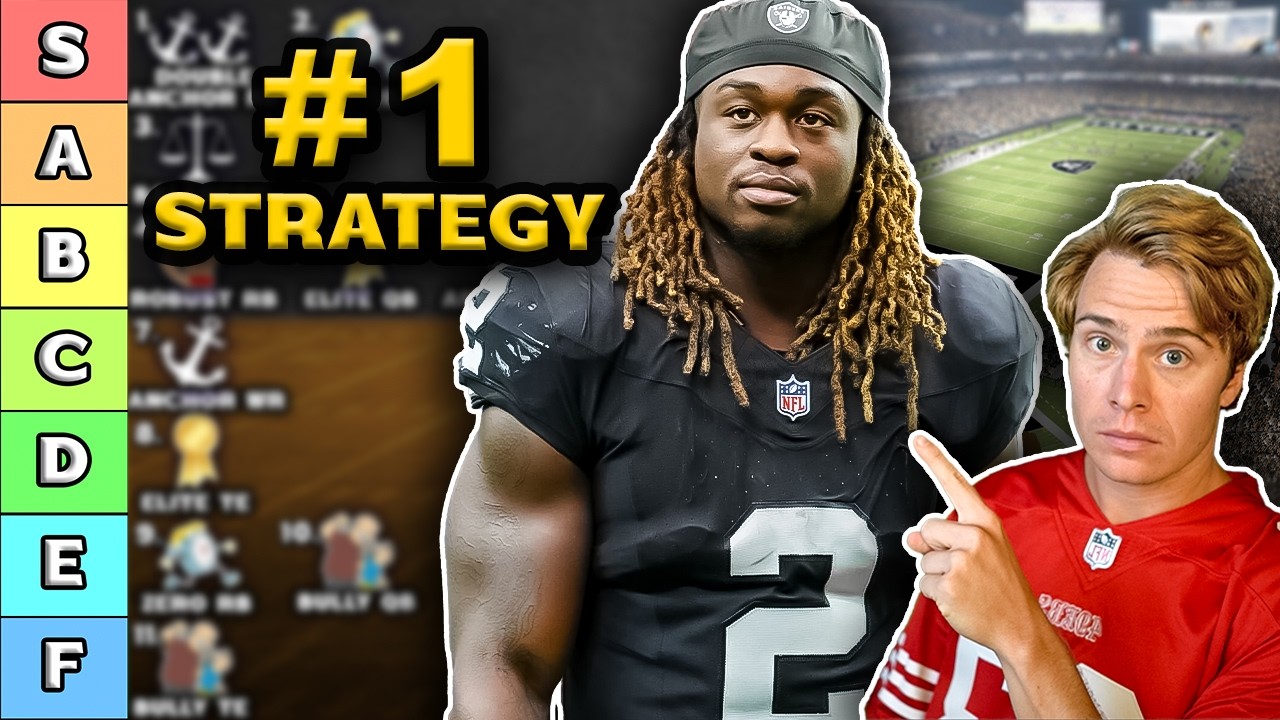
Top 10 Draft Strategy Rankings & Tiers
STACKED extracted the fantasy-relevant player signal from this video and kept the full transcript here for context.
Player insights
A.J. Brown
Used as an anchor wide receiver in a draft strategy example where two elite WRs are selected in the first two picks alongside Jaxson Smith-Njigba, then paired with elite tight end Trey McBride before catching up on running back depth with Josh Jacobs and TreVeyon Henderson. The source illustrates this anchor WR strategy prioritizes elite WR1/WR2 production in rounds 1–2, trading WR3/WR4 quality for top-tier upside; however, the strategy historically yields only 16.4% playoff success rate over five years, with weak WR depth (Romeo Dobbs as WR3, Jaylen Coker as WR4) representing a significant weakness.
Insight pageAaron Jones
Aaron Jones was part of the RB room in the bully QB strategy example draft (Josh Allen round 2, Dak Prescott round 6); the source notes this RB group was insufficient, indicating that early QB investment compromised RB depth. Listed as part of a running back group (Devon Achane, Aaron Jones, Keaton Mitchell, Jamaal Williams, Alvin Kamara, Emmitt Johnson) used in a draft strategy example to illustrate mid-round running back depth.
Insight pageAlvin Kamara
Alvin Kamara was part of the RB room in the bully QB strategy example draft (Josh Allen round 2, Dak Prescott round 6); the source notes this RB group was insufficient, indicating that early QB investment compromised RB depth. Listed as part of a running back group (Devon Achane, Aaron Jones, Keaton Mitchell, Jamaal Williams, Alvin Kamara, Emmitt Johnson) used in a draft strategy example to illustrate mid-round running back depth.
Insight pageAnthony Richardson
The source lists Anthony Richardson (referred to as 'Daniels' in context) among elite quarterbacks (Josh Allen, Lamar Jackson, Burrow, Daniels, Caleb, Jalen Hurts, Drake Maye) and advises that taking one of these elite QBs early means you should not draft a second QB until possibly the last round.
Insight pageAshton Jeanty
Drafted at pick 12 in a robust running back draft strategy example, paired with James Cook (pick 13) and Kyren Williams (pick 37). The source notes the robust RB strategy has been popular because over the past two years running backs have been injured at significantly lower rates than historically, top-drafted RBs finished as top fantasy performers, and there were no notable waiver-wire RB league winners. In an expensive running back season, Jeanty is being pushed up to the 11th or 12th overall pick rather than a 15th overall pick in a cheap RB year; the delta in being overdrafted at RB isn't large, and he offers guaranteed touches and guaranteed points early in the draft despite the premium cost.
Insight pageBo Nix
Late-round quarterback that can be pushed to the final round of drafts in smart league settings; the source advises that if all eight elite quarterbacks are off the board and league mates are smart players who don't double up on QBs early, Bo Nix can be deferred until the last round, allowing drafters to maximize value at premium positions.
Insight pageBrock Bowers
Taking Bowers in round 2 (pick 20) as part of a bully tight end strategy creates significant opportunity cost; forces sacrifice of elite WR or RB options like Rashee Rice or Jeremiah Love, leaving rosters underpowered at critical positions. Historical data shows teams taking two tight ends in the first six rounds make playoffs only 13% of the time in Best Ball Mania (54,000 teams over 2 million samples). However, the source also notes that in specific league formats—particularly leagues starting only two wide receivers and one flex where tight end position makes up a very high percentage of starting lineup output—taking Bowers in round two would be advantageous; this contrasts with leagues requiring three wide receivers or multiple flex spots where early tight end selection is less valuable.
Insight pageBrock Purdy
Poor draft value when taken in round eight; the source illustrates that casual league teams selecting elite QBs like Lamar Jackson may still redundantly draft Brock Purdy in round eight, a wasteful pattern that smart players avoid by deferring backup QB selection to late rounds or waiver wire.
Insight pageCaleb Williams
Elite QB strategy: Caleb Williams goes off the board in round 6 alongside Jayden Daniels, Joe Burrow, and Jalen Hurts. The source argues elite QBs are cheaper than elite tight ends (Bowers round 2, McBride round 3, Loveland round 4) and more predictable, making them a superior draft strategy with 16.3% historical playoff success rate in Underdog drafts. If taking one of these elite QBs early, do not draft a second QB until the last round of redraft leagues.
Insight pageCole Kmet
Cole Kmet mentioned as part of bully tight end strategy discussion; taking Kmet in round 4 alongside earlier tight end investments (Bowers, McBride) exemplifies the roster flexibility problem that causes teams taking two tight ends in first six rounds to make playoffs only 13% of the time.
Insight pageCourtland Sutton
Recommended as a WR catch-up target immediately after implementing a robust running back draft strategy. Grouped with Tee Higgins, Rondale Moore, and Zay Jones as the tier to target for WR depth if you start with three RBs in your first three picks. The source emphasizes you must immediately pivot to these WR options to avoid falling too far behind at the position.
Insight pageDak Prescott
Dak Prescott taken at pick 81 (round 6) in a bully quarterback strategy example alongside Josh Allen at pick 33; this two-QB approach left the roster severely underpowered at running back. Bully QB strategy (two QBs in first six rounds) has only 14% playoff rate in Underdog drafts. The source advises against taking second QB before round 8 in Underdog drafts. Dak also exemplifies redundant early-round quarterback selection by league mates who already took an elite QB; casual league teams selecting Josh Allen may still take Dak Prescott as a second QB, a wasteful draft pattern that smart players avoid by deferring backup QB selection to late rounds.
Insight pageDe'Von Achane
Devon Achane was part of the RB room in the bully QB strategy example draft (Josh Allen round 2, Dak Prescott round 6); the source notes this RB group was insufficient, indicating that early QB investment compromised RB depth. Listed as part of a running back group (Devon Achane, Aaron Jones, Keaton Mitchell, Jamaal Williams, Alvin Kamara, Emmitt Johnson) used in a draft strategy example to illustrate mid-round running back depth.
Insight pageDeVonta Smith
In a zero running back draft strategy example, the source paired Jalen Hurts at pick 68 with DeVonta Smith, illustrating a QB-WR stack approach within a zero RB framework.
Insight pageDrake Maye
Drake Maye is grouped among elite quarterbacks (Josh Allen, Lamar Jackson, Joe Burrow, Jayden Daniels, Caleb Williams, Jalen Hurts) in the source's draft strategy framework. The source advises that if you take one of these elite QBs early, you should not draft a second quarterback until the last round of redraft leagues, indicating Maye's elite-tier status justifies early selection and delayed secondary QB acquisition.
Insight pageEmmett Johnson
Emmitt Johnson was part of the RB room in the bully QB strategy example draft (Josh Allen round 2, Dak Prescott round 6); the source notes this RB group was insufficient, indicating that early QB investment compromised RB depth. Listed as part of a running back group (Devon Achane, Aaron Jones, Keaton Mitchell, Jamaal Williams, Alvin Kamara, Emmitt Johnson) used in a draft strategy example to illustrate mid-round running back depth.
Insight pageJ.K. Dobbins
Selected as the third running back pick in round 10 within a double anchor RB strategy example. This demonstrates the strategy's approach of securing two elite RBs early (Jonathan Taylor and Saquon Barkley), then waiting until after round 6 for the third RB while securing elite talent at other positions in the middle rounds.
Insight pageJalen Coker
Ends up as WR4 in an anchor-WR draft strategy example, further illustrating the depth chart weakness of this approach. The source uses Coker as evidence that despite the wide receiver position's historically high hit rate and low injury risk, the anchor WR strategy sacrifices WR3/WR4 quality and results in only 16.4% historical playoff success rate over five years.
Insight pageJalen Hurts
Elite QB strategy: Jalen Hurts goes off the board in round 6 alongside Caleb Williams, Jayden Daniels, and Joe Burrow. The source argues elite QBs are cheaper than elite tight ends and more predictable, making them a superior draft strategy with 16.3% historical playoff success rate in Underdog drafts. If taking one of these elite QBs early, do not draft a second QB until the last round of redraft leagues.
Insight pageJamaal Williams
Jamaal Williams was part of the RB room in the bully QB strategy example draft (Josh Allen round 2, Dak Prescott round 6); the source notes this RB group was insufficient, indicating that early QB investment compromised RB depth. Listed as part of a running back group (Devon Achane, Aaron Jones, Keaton Mitchell, Jamaal Williams, Alvin Kamara, Emmitt Johnson) used in a draft strategy example to illustrate mid-round running back depth.
Insight pageJames Cook
Drafted at pick 13 in a robust running back draft strategy example, paired with Ashton Jeanty (pick 12) and Kyren Williams (pick 37). The source illustrates the robust RB strategy, which has been popular because over the past two years running backs have been injured at significantly lower rates, top-drafted RBs finished as top fantasy performers, and there were no notable waiver-wire RB league winners.
Insight pageJavonte Williams
Cited as an example of a running back being overvalued relative to wide receivers in middle rounds, potentially getting drafted ahead of Rashee Rice despite inferior value. This illustrates the running back inflation problem the double anchor RB strategy aims to avoid by securing two elite RBs early (Jonathan Taylor and Saquon Barkley in the example) and then waiting until round 10 for the third RB (JK Dobbins), allowing the drafter to pivot to elite wide receivers and other positions in the middle rounds.
Insight pageJaxon Smith-Njigba
Jaxson Smith-Njigba is used as an anchor wide receiver in a draft strategy example, selected in the first two picks alongside A.J. Brown, then paired with elite tight end Trey McBride before catching up on running back depth. This demonstrates the anchor wide receiver strategy of taking two elite WRs early and delaying the third WR. The source reports this anchor WR strategy has only 16.4% historical playoff success rate over five years, indicating vulnerability despite early WR firepower.
Insight pageJayden Daniels
Going off the board in round 6 alongside Caleb Williams, Joe Burrow, and Jalen Hurts as part of an elite quarterback draft strategy. The source argues elite QBs are cheaper than elite tight ends and more predictable, supporting this strategy with 16.3% historical playoff success rate in Underdog drafts.
Insight pageJeremiyah Love
Jeremiah Love represents the opportunity cost of bully tight end strategy; taking Bowers in round 2 forces sacrifice of Love in round 2 at running back, leaving rosters underpowered at the critical RB position. The source emphasizes this creates a roster construction problem that limits flexibility.
Insight pageJoe Burrow
Elite QB strategy: Joe Burrow goes off the board in round 6 alongside Caleb Williams, Jayden Daniels, and Jalen Hurts. The source argues elite QBs are cheaper than elite tight ends and more predictable, making them a superior draft strategy with 16.3% historical playoff success rate in Underdog drafts. If taking one of these elite QBs early, do not draft a second QB until the last round of redraft leagues.
Insight pageJonathan Taylor
Jonathan Taylor is used as an example of an elite early-round running back anchor; the source notes that teams drafting Taylor early would dominate against zero RB teams in redraft leagues, illustrating the value of securing a workhorse RB early. Taylor was also selected as the first running back anchor in a double anchor RB strategy example, allowing the drafter to avoid running back landmines in the middle rounds and pivot to elite wide receivers and other positions.
Insight pageJosh Allen
Taking Josh Allen at pick 33 (round 2) in a bully quarterback strategy example left the roster underpowered at running back. The source tested this strategy and found it resulted in weak RB depth (Devon Achane, Aaron Jones, Keaton Mitchell, Jamaal Williams, Alvin Kamara, Emmitt Johnson). Bully QB strategy (two QBs in first six rounds) has only 14% playoff rate in Underdog drafts. However, the source also identifies Josh Allen as an elite quarterback tier; when drafting an elite QB like Allen in early rounds, the source advises waiting until round eight or later for a second quarterback in Underdog Fantasy drafts, indicating elite QB value justifies delayed secondary QB selection. Going at the 3-4 turn in drafts, Josh Allen finishes as the number one overall quarterback in fantasy year after year, playing 17 games every season. Historical data shows 16.3% of teams selecting a QB in the first four rounds made the playoffs in Underdog drafts.
Insight pageJosh Jacobs
Used as a running back catch-up pick in an anchor-WR draft strategy example, selected after securing two elite WRs (Smith-Njigba, A.J. Brown) and elite tight end (McBride), paired with TreVeyon Henderson to address the running back position later in the draft. This represents the RB depth tier in a strategy that delays running back investment until after locking in positional advantage at WR and TE.
Insight pageKeaontay Ingram
In a zero running back draft strategy example, Keaontay Ingram was one of seven running backs drafted late (Rhamondre Stevenson, Romeo Dobbins, Anthony Dobbins, Aaron Jones, Singleton, Alvin Kamara, Keaontay Ingram). The source criticizes this approach, noting that in redraft leagues, teams with early RB anchors would dominate, making the zero RB strategy's reliance on late-round RB depth unsustainable.
Insight pageKeaton Mitchell
Keaton Mitchell was part of the RB room in the bully QB strategy example draft (Josh Allen round 2, Dak Prescott round 6); the source notes this RB group was insufficient, indicating that early QB investment compromised RB depth. Listed as part of a running back group (Devon Achane, Aaron Jones, Keaton Mitchell, Jamaal Williams, Alvin Kamara, Emmitt Johnson) used in a draft strategy example to illustrate mid-round running back depth.
Insight pageKyren Williams
Strong value at pick 37 in a robust running back draft strategy that pairs early RB anchors (Ashton Jeanty at pick 12, James Cook at pick 13) with later-round RB depth. The source states 'I just simply have to take him' at pick 37, illustrating the strategy's ability to find quality RB production in later rounds. This approach works because over the past two years running backs have been injured at significantly lower rates than historically, top-drafted RBs finished as top fantasy performers, and there were no notable waiver-wire RB league winners.
Insight pageLamar Jackson
Lamar Jackson is positioned as an elite quarterback going around pick 5 in drafts. The source identifies him alongside Josh Allen (picks 3–4) and round-six QBs (Caleb Williams, Jayden Daniels, Joe Burrow, Jalen Hurts) as top-tier options. The source advises that if you draft Lamar Jackson in round five, you should not take another elite QB like Caleb Williams in round six, indicating elite QB value justifies delayed secondary QB selection. The source argues elite QBs are cheaper than elite tight ends and more predictable, with the elite QB strategy showing 16.3% historical playoff success rate.
Insight pageRashee Rice
Rashee Rice represents the opportunity cost of bully tight end strategy; if taken in round 3 instead of McBride, Rice could fill WR1, WR2, WR3, or flex, providing more roster flexibility than a tight end locked into flex. The source emphasizes that even if McBride outscores Rice, the positional flexibility of Rice makes it the superior draft choice in standard league formats.
Insight pageRhamondre Stevenson
In a zero running back draft strategy example, Rhamondre Stevenson was the source's first running back selection at pick 77, illustrating the delayed RB acquisition in zero RB strategies. The source criticizes this approach, noting that in redraft leagues with limited RB starting slots, teams with early RB anchors like Jonathan Taylor would dominate, making the zero RB strategy vulnerable.
Insight pageRomeo Doubs
Ends up as WR3 in an anchor-WR draft strategy example and explicitly flagged as a weakness of the approach. The source identifies Dobbs as evidence that the strategy's emphasis on elite WR1/WR2 and tight end leaves insufficient firepower at the third wide receiver spot, representing the quality drop-off. Despite the wide receiver position historically having a higher hit rate and lower injury risk in early-to-middle rounds, this strategy results in only 16.4% historical playoff success rate over five years.
Insight pageRondale Moore
Recommended as a WR catch-up target immediately after implementing a robust running back draft strategy. Grouped with Tee Higgins, Zay Jones, and Courtland Sutton as the tier to target for WR depth if you start with three RBs in your first three picks. The source emphasizes you must immediately pivot to these WR options to avoid falling too far behind at the position.
Insight pageSaquon Barkley
Selected as the second running back anchor in a double anchor RB strategy example alongside Jonathan Taylor. This pairing allows the drafter to avoid running back landmines in the middle rounds and pivot to elite wide receivers and other positions, while waiting until round 10 for the third RB (JK Dobbins).
Insight pageTee Higgins
Recommended as a WR catch-up target immediately after implementing a robust running back draft strategy. Grouped with Rondale Moore, Zay Jones, and Courtland Sutton as the tier to target for WR depth if you start with three RBs in your first three picks. The source emphasizes you must immediately pivot to these WR options to avoid falling too far behind at the position and being unable to find consistency on the waiver wire.
Insight pageTreVeyon Henderson
Used as a running back catch-up pick in an anchor-WR draft strategy example, selected after securing two elite WRs (Smith-Njigba, A.J. Brown) and elite tight end (McBride), paired with Josh Jacobs to address the running back position later in the draft. This represents the RB depth tier in a strategy that delays running back investment until after locking in positional advantage at WR and TE.
Insight pageTrey McBride
Taking McBride in round 3 (pick 29) as part of a bully tight end strategy limits roster flexibility; even if McBride outscores the WR you would have taken (e.g., Rashee Rice), that WR could fill WR1, WR2, WR3, or flex, whereas McBride only fits flex if you already have Bowers. Teams taking two tight ends in first six rounds make playoffs only 13% of the time. Post-draft trade attempts fail because league mates recognize the need to sell and demand discounts. However, the source believes taking McBride in round three would be advantageous in specific league settings—particularly leagues that start only two wide receivers and one flex, where tight end position makes up a very high percentage of starting lineup output. The source also uses McBride as the elite tight end target in an anchor-WR draft strategy, securing him after two premium wide receivers (Smith-Njigba and A.J. Brown) to lock in positional advantage before addressing running back depth.
Insight pageZay Jones
Recommended as a WR catch-up target immediately after implementing a robust running back draft strategy. Grouped with Tee Higgins, Rondale Moore, and Courtland Sutton as the tier to target for WR depth if you start with three RBs in your first three picks. The source emphasizes you must immediately pivot to these WR options to avoid falling too far behind at the position.
Insight pageEpisode Transcript
More episodes from Flock Fantasy